Published: September 2026| Audience: CAUTO Global -For EV Importers, Dealers & Fleet Operators
Shipping an electric vehicle from China in 2026 is not the same as it was in 2024. The rules have changed, the stakes have risen, and the margin for error has narrowed to almost zero. On January 1, 2026, the International Maritime Dangerous Goods (IMDG) Code Amendment 42-24 became mandatory globally, replacing the generic UN 3171 classification with chemistry-specific codes: UN 3556 for lithium-ion, UN 3557 for lithium-metal, and UN 3558 for sodium-ion battery-powered vehicles. A single incorrect UN number on a booking form now triggers automatic rejection by major carriers like Maersk, MSC, and COSCO.
Yet despite the regulatory tightening, China exported over 1.2 million electric vehicles in the first half of 2026 alone. The infrastructure exists. The demand is global. The question is not whether you can ship an EV from China—it is which transport mode best fits your destination, timeline, and budget.
This guide covers the three primary methods for shipping an electric car from China in 2026: sea freight (the global standard), China-Europe Railway Express (the overland alternative), and land transport by truck (the regional solution). Each method has distinct advantages, regulatory requirements, and cost structures. Understanding all three allows you to build a resilient supply chain that adapts to port congestion, route disruptions, and shifting carrier policies.
The 2026 Regulatory Foundation: What Every Shipper Must Know
Before comparing transport modes, understand the regulatory framework that applies to all EV shipments from China, regardless of method.
The UN Number Revolution
| Old Code (Obsolete) | New Code (Mandatory since Jan 1, 2026) | Battery Chemistry |
|---|---|---|
| UN 3171 (Battery-powered vehicle) | UN 3556 | Lithium-ion |
| — | UN 3557 | Lithium-metal |
| — | UN 3558 | Sodium-ion |
Critical Rule: Any booking, declaration, or document referencing UN 3171 for a lithium-ion EV is now classified as misdeclaration. Carriers will reject the booking. Customs may seize the cargo. Criminal liability for dangerous goods misdeclaration applies in most jurisdictions.
Universal Documentation Requirements
Regardless of transport mode, every EV shipment requires:
| Document | Purpose | Who Provides It |
|---|---|---|
| UN 38.3 Test Summary | Proves battery pack passed safety testing | Vehicle manufacturer |
| Material Safety Data Sheet (MSDS) | Details battery chemistry, hazards, handling procedures | Vehicle manufacturer |
| Dangerous Goods Declaration (DGD) | Declares UN classification, battery specs, state of charge | Shipper / freight forwarder |
| Battery State of Charge (SoC) Record | Documents charge level at time of loading | Shipper / carrier |
| Commercial Invoice | Vehicle price, VIN, specifications | Seller |
| Certificate of Origin | Required for tariff exemptions (e.g., Panama Law 295, Uruguay) | Chamber of Commerce in China |
| Vehicle Condition Report | Confirms no damage, no active warning lights, no open recalls | Pre-shipment inspector |
Battery SoC Guidelines:
- Air freight: Strict 30% maximum SoC (IATA DGR 67th Edition)
- Sea freight: No universal limit; carrier-specific rules typically 30–50%; BYD factory protocol ships at 30–50%
- Rail freight: Typically 30–50% aligned with sea freight standards
- Road freight: Typically 30–50%; national regulations may vary
Method 1: Sea Freight — The Global Standard
Sea freight remains the dominant method for shipping EVs from China, handling approximately 85% of global EV export volume. It offers the lowest cost per vehicle for long-distance routes and accommodates everything from single units to thousand-vehicle fleets.

Two Sea Freight Options
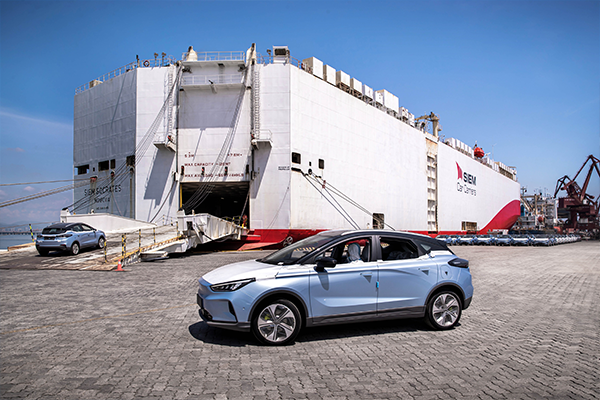
Option A: RoRo (Roll-on/Roll-off)
| Factor | Details |
|---|---|
| How it works | Vehicle is driven onto the vessel, secured in a dedicated vehicle hold, driven off at destination |
| Cost per vehicle | 1,500–1,500–3,000 (China to Panama/Europe/Middle East) |
| Transit time | 30–45 days (China–Panama); 28–35 days (China–Europe); 14–18 days (China–US West Coast) |
| Best for | Operational vehicles; single units to medium fleets (1–50 vehicles) |
| Carriers | COSCO, Grimaldi, Wallenius Wilhelmsen, Höegh Autoliners |
| Advantages | Most economical; no crating; fastest booking turnaround |
| Risks | Exposure to salt spray/humidity; potential for minor cosmetic damage; limited to operational vehicles |
Special Provision 961 (IMDG Code): Vehicles carried on RoRo ships with flag-approved vehicle spaces may be exempt from full dangerous goods declaration if the battery is protected from short circuit, there is no leakage, and the vehicle is undamaged. This is why most operational EVs move via RoRo without the full Class 9 placarding required for container shipments.
Option B: Container Shipping (FCL or LCL)
| Factor | Details |
|---|---|
| How it works | Vehicle is loaded into a sealed 20′ or 40′ container, secured with blocking and bracing |
| Cost per vehicle | 2,500–2,500–4,000 (FCL 40′); 1,800–1,800–2,500 (LCL shared) |
| Transit time | 35–50 days (slightly longer than RoRo due to handling complexity) |
| Best for | High-value vehicles; non-operational units; bulk shipments (3+ vehicles per container) |
| Carriers | Maersk, MSC, CMA CGM, COSCO |
| Advantages | Maximum protection; can include spare parts; lower per-unit cost at volume |
| Risks | Higher cost for single units; requires professional loading; full DG placarding required |
Container Placarding (2026 New Rule): Under IMDG Amendment 42-24, containers carrying EVs must display Class 9 dangerous goods placards on all four sides (front, rear, left, right). This is a significant change from previous practice and requires coordination with the container packing facility.
Sea Freight Cost Comparison by Volume
| Vehicle Count | RoRo Total | Container FCL (40′) | Recommended Method |
|---|---|---|---|
| 1 vehicle | $1,800 | $3,200 | RoRo |
| 2–3 vehicles | $5,400 | $3,200 | Container |
| 4 vehicles | $7,200 | $3,200 | Container (44% savings vs. RoRo) |
| 10+ vehicles | $18,000+ | $6,000+ (2× FCL) | Container or dedicated vehicle carrier |
Major Departure Ports in China
| Port | Best For | Advantages |
|---|---|---|
| Shanghai | Large-volume orders; Europe routes | Most competitive rates; highest carrier density |
| Shenzhen (Yantian/Shekou) | Time-sensitive; Latin America | Closest to BYD/Chery/Geely factories; frequent sailings |
| Ningbo | Cost-sensitive; Geely vehicles | Often cheaper than Shanghai; less congestion |
| Guangzhou (Nansha) | PRD suppliers; mixed cargo | Convenient for regional manufacturers |
Method 2: China-Europe Railway Express — The Overland Alternative
The China-Europe Railway Express (CER) has emerged as a viable middle ground between the slow pace of sea freight and the high cost of air cargo. Operating on a network of rail corridors stretching from China’s interior to Europe via Kazakhstan, Russia, Belarus, and Poland, the CER offers a 12–18 day transit time at roughly 50% higher cost than sea freight.
How CER Works for EVs
| Factor | Details |
|---|---|
| Route | China (Xi’an/Zhengzhou/Wuhan) → Kazakhstan → Russia → Belarus → Poland → Germany/Netherlands/Belgium |
| Transit time | 12–18 days (vs. 28–35 days by sea) |
| Cost per vehicle | 3,000–4,000–6,000 (40-foot container carrying 2–3 vehicles) |
| Frequency | Daily departures from major hubs during peak season |
| Best for | European markets; time-sensitive inventory; avoiding Red Sea disruptions |
| Advantages | Faster than sea; lower carbon footprint; avoids maritime chokepoints |
| Risks | Route instability (geopolitical); winter weather delays; limited to Eurasian corridor |
EV-Specific Considerations for Rail
1. Temperature Extremes: The CER crosses Siberia and Central Asia, where winter temperatures drop to -30°C. Lithium-ion batteries lose 20–40% of their effective capacity in extreme cold. Pre-shipment battery conditioning and insulated container lining are recommended for winter shipments.
2. Multi-Modal Handlings: The journey involves at least three gauge changes (China standard gauge → Kazakhstan broad gauge → Europe standard gauge), requiring containers to be lifted and transferred at border terminals. Each handling increases risk of minor damage if vehicles are not properly secured.
3. Dangerous Goods Compliance: Rail transport of EVs falls under the ADR (European Agreement concerning the International Carriage of Dangerous Goods by Road) and RID (Regulations concerning the International Carriage of Dangerous Goods by Rail) frameworks. The UN 3556 classification applies, and containers must carry appropriate DG markings.
4. Insurance Complexity: CER shipments involve multiple carriers across multiple jurisdictions. All-risk cargo insurance with specific lithium battery coverage is essential—standard marine cargo policies may not cover rail segments adequately.
When to Choose CER Over Sea
- European destination with tight inventory deadlines: If you need vehicles in Rotterdam in 15 days rather than 35, CER is the only viable alternative to air freight (which costs 8–10× more).
- Red Sea disruption avoidance: Geopolitical tensions in the Suez Canal region have caused significant sea freight delays. CER offers a reliable overland bypass.
- Sustainability requirements: Rail produces approximately 75% less CO₂ per ton-kilometer than sea freight. For importers with carbon reduction commitments, CER supports ESG reporting.
Method 3: Land Transport by Truck — The Regional Solution
For shorter distances and regional markets, road freight offers unmatched flexibility. Trucks can move EVs from Chinese factories to neighboring countries (Vietnam, Laos, Myanmar, Central Asia) or to transhipment hubs (Kazakhstan border for CER, Russian Far East for onward rail).
How Road Transport Works for EVs
| Factor | Details |
|---|---|
| Range | China to neighboring countries; domestic China to port/rail hub; cross-border to Central Asia/Southeast Asia |
| Transit time | 3–7 days (regional); 10–15 days (long-haul to Central Asia) |
| Cost per vehicle | 500–500–1,500 (regional); 2,000–2,000–3,500 (long-haul) |
| Vehicle configuration | Flatbed trucks (operational EVs); enclosed car carriers (high-value units); container trucks (non-operational) |
| Best for | Regional distribution; last-mile delivery to port/rail terminal; markets without direct sea access |
| Advantages | Maximum flexibility; door-to-door service; fastest for short distances |
| Risks | Road conditions in developing regions; border crossing delays; driver qualification for DG cargo |
EV-Specific Considerations for Road
1. Driver Training: In most jurisdictions, drivers transporting Class 9 dangerous goods must hold a ADR certificate (Europe) or equivalent national qualification. The driver must understand emergency procedures for lithium battery incidents, including the use of Class D fire extinguishers (for metal fires) and isolation protocols.
2. Vehicle Securement: Unlike sea containers where vehicles are blocked and braced, road transport requires wheel chocks, tie-down straps rated for dynamic loads, and anti-sway bars. EVs are heavier than comparable ICE vehicles (due to batteries) and require higher-rated securing equipment.
3. Border Crossings: Moving EVs across borders by truck involves customs declarations in both origin and destination countries. The Certificate of Origin, commercial invoice, and dangerous goods documentation must be prepared in the language of each transit country—not just the final destination.
4. Charging En Route: For operational EVs being driven (rather than transported on a carrier), route planning must include charging infrastructure. China’s highway network now has extensive charging stations, but coverage thins significantly west of Lanzhou and in Central Asian transit countries.
When to Choose Road Transport
- Final-mile delivery to port: Moving vehicles from an interior factory (e.g., BYD’s Xi’an plant) to Shanghai port by truck is standard practice and often cheaper than rail for distances under 1,000 km.
- Southeast Asian markets: Trucks move EVs from Guangxi/Yunnan across the Vietnam/Laos/Myanmar borders for regional distribution.
- Central Asian distribution: Road freight from Xinjiang to Kazakhstan, Uzbekistan, and Kyrgyzstan is faster than sea via Iran or Pakistan.
Comparative Analysis: Which Method Is Right for You?
| Factor | Sea Freight (RoRo) | Sea Freight (Container) | China-Europe Railway | Road Transport |
|---|---|---|---|---|
| Cost per vehicle | 1,500–1,500–3,000 | 2,500–2,500–4,000 | 3,000–4,000–6,000 | 1500–3,500 |
| Speed | Slow (30–45 days) | Slow (35–50 days) | Medium (12–18 days) | Fast (3–15 days) |
| Distance | Unlimited | Unlimited | Eurasia only | Regional/continental |
| Volume flexibility | 1–1,000+ units | 3+ units optimal | 2–4 per container | 1–10 per truck |
| Damage risk | Moderate (salt/humidity) | Low (sealed container) | Moderate (handlings) | Moderate (road conditions) |
| DG complexity | Low (SP 961 exemption) | High (full placarding) | Medium (RID/ADR) | Medium (national ADR) |
| Best destination | Global | Global | Europe/Central Asia | Neighboring countries |
| Carbon footprint | Medium | Medium | Low | High (per km) |
Decision Framework:
- Shipping to Latin America, Africa, or Oceania? → Sea freight only (RoRo for operational units; container for bulk/value)
- Shipping to Europe with 20-day deadline? → China-Europe Railway Express
- Shipping to Europe with 40-day flexibility? → Sea freight (50% cheaper than rail)
- Shipping to Vietnam, Kazakhstan, or Russia? → Road transport (fastest and most flexible)
- Shipping 1–2 premium vehicles anywhere? → Container sea freight (maximum protection)
- Shipping 50+ units to any destination? → RoRo sea freight (lowest per-unit cost)
Working With a Multi-Modal Export Partner
The complexity of EV shipping in 2026 extends beyond choosing a transport mode. It requires expertise in Chinese export customs, international dangerous goods regulations (IMDG, ADR, RID), and destination country import requirements. Most importers are experts in none of these domains.
CAUTO Global—China Automotive Global Supply Chain Co., Limited—a reliable china auto exporter, help provides suitable electric car models and integrated multi-modal export management for EV shipments from China. Unlike freight forwarders who specialize in a single mode, CAUTO Global help manages sea, rail, and road transport as an integrated network, selecting the optimal mode or combination for each destination and timeline.
For global car importers, CAUTO Global’s value includes:
- Mode Selection Advisory: Analyzing destination, volume, budget, and timeline to recommend sea, rail, road, or a multi-modal combination (e.g., truck to Shanghai → RoRo to Panama → truck to final destination)
- Dangerous Goods Compliance: Ensuring UN 3556/3557/3558 classification, UN 38.3 documentation, and SoC verification are correct before the vehicle leaves the factory
- Certificate of Origin Management: Procuring Chamber of Commerce certification in China before shipment—critical for tariff exemptions in Panama (Law 295), Uruguay, and other markets
- Pre-Shipment Inspection: Multi-point mechanical, electrical, cosmetic, and compliance verification at the factory gate
- Multi-Brand Consolidation: Combining BYD, Geely, Chery, and other brands into a single shipment to reduce per-unit logistics costs
Whether your shipment requires a single RoRo booking to Balboa, a CER container to Rotterdam, or a truck convoy to Tashkent, CAUTO Global structures the transaction to ensure compliance at every border crossing and handover point. In an environment where one incorrect UN number can strand an entire shipment, this integrated approach is not a luxury—it is a necessity.
Frequently Asked Questions
Q: What is the cheapest way to ship an EV from China?
A: For long-distance international routes, RoRo sea freight is the most cost-effective method at 1,500–1,500–3,000 per vehicle. For regional routes (under 2,000 km), road transport at 1500-3500 is cheapest. For Europe with time pressure, CER rail at 3,000–4,000–6,000 offers the best speed-to-cost ratio.
Q: Can I ship a used EV from China?
A: Yes, but with significant restrictions. Used EVs require battery condition verification, no total-loss certificates, and may face age limits (many markets restrict imports to vehicles under 5 years old). Carrier acceptance for used EVs is also more restrictive than for new vehicles. Most commercial importers focus on new vehicles.
Q: What happens if I use the old UN 3171 code?
A: Automatic booking rejection. Major carriers implemented automated filters in January 2026 that flag any dangerous goods declaration using UN 3171 for lithium-ion vehicles. The booking will not be accepted. If the error is discovered after loading, the container may be offloaded at the next port, incurring storage fees, demurrage, and potential fines for misdeclaration.
Q: How do I choose between RoRo and container for sea freight?
A: Choose RoRo for 1–2 operational vehicles where cost is the priority. Choose container for 3+ vehicles, high-value/premium vehicles, non-operational units, or when maximum protection against salt and humidity is required.
Q: Is the China-Europe Railway Express reliable?
A: Generally yes, with 12–18 day transit times and daily departures during peak season. However, geopolitical tensions along the route (particularly involving Russia and Belarus) can cause delays or route changes. Winter weather in Siberia can also extend transit times by 3–5 days. CER is best used with buffer time built into inventory planning.
Q: Do I need special insurance for EV shipping?
A: Yes. Standard marine cargo insurance may exclude lithium battery incidents or limit coverage for thermal runaway events. Ensure your policy specifically covers “all risks including battery-related damage” and verify that coverage extends across all transport modes if using multi-modal shipping.
Q: Can I track my EV shipment in real time?
A: For sea freight, carriers provide vessel tracking via their websites using the Bill of Lading number. For CER rail, most operators offer container tracking via GPS. For road transport, truck GPS tracking is standard with most carriers. Real-time visibility is now the industry norm, not the exception.
Building a Resilient EV Supply Chain
The Chinese EV export boom of 2026 is not a temporary phenomenon—it is a structural shift in global automotive trade. With over 60% of the world’s EVs manufactured in China and export volumes growing 30%+ year-over-year, the infrastructure to move these vehicles globally is maturing rapidly. But maturity does not mean simplicity.
For importers and dealers, the competitive advantage in 2026 is not just about sourcing the right vehicle at the right price. It is about building a supply chain that can adapt—switching from sea to rail when the Suez Canal is disrupted, from RoRo to container when carrier policies change, from road to rail when border crossings slow.
The vehicles are in China. The demand is global. The transport options are sea, rail, and road. The only question is whether your logistics partner can navigate all three.
Ready to ship your first electric vehicle from China? Start with a regulatory compliance audit, confirm your target market’s charging standard and import requirements, and select the transport mode that balances your timeline, budget, and risk tolerance.
About CAUTO Global
CAUTO Global (China Automotive Global Supply Chain Co., Limited) is a leading automobile export company headquartered in Hubei, China, with over 10 years of experience in the automotive industry. We specialize in delivering high-quality Chinese vehicles — passenger cars, SUVs, commercial vehicles, hybrids and new energy vehicles ,electric cars— to more than 50 countries across Asia, the Middle East, Africa, Europe and the Americas, at factory-direct pricing.
What we offer:
- 🚗 Vehicle export — provide different car brands (BYD, Li Auto, Geely, AITO, Zeekr, Voyah, Dongfeng and more), covering sedans, SUVs, MPVs, commercial vehicles and NEVs
- 🔧 SKD / CKD / OEM projects — one-stop turnkey automotive production lines: welding, painting, final assembly and inspection lines, with design, installation, commissioning and training
- 🌍 Market compliance — RHD/LHD configurations and WVTA, GCC, Euro 5/6 and other regional certification support
- 📄 Full documentation service — commercial invoice, packing list, bill of lading, certificate of origin, export license and destination-market compliance certificates
- 🚢 Global logistics — RoRo and container shipping ,land transport , rail with port handling, insurance and real-time tracking; typical delivery 15–45 days depending on destination
Our mission is to deliver reliable, affordable, high-performance vehicles to customers worldwide, with exceptional service throughout the entire purchasing and shipping process.
Keywords: ship electric car from China, China EV export shipping, sea freight EV China, China Europe Railway Express EV, road transport EV China, UN 3556 shipping, IMDG Code 2026 EV, RoRo vs container EV, CAUTO Global, Reliable china car supplier ,multi-modal EV transport